Technology
How Oscivara creates and plays sound
Some work happens in your browser and some tasks run in the cloud. Understanding the difference helps explain loading, delays and project behaviour without needing to know how to program.
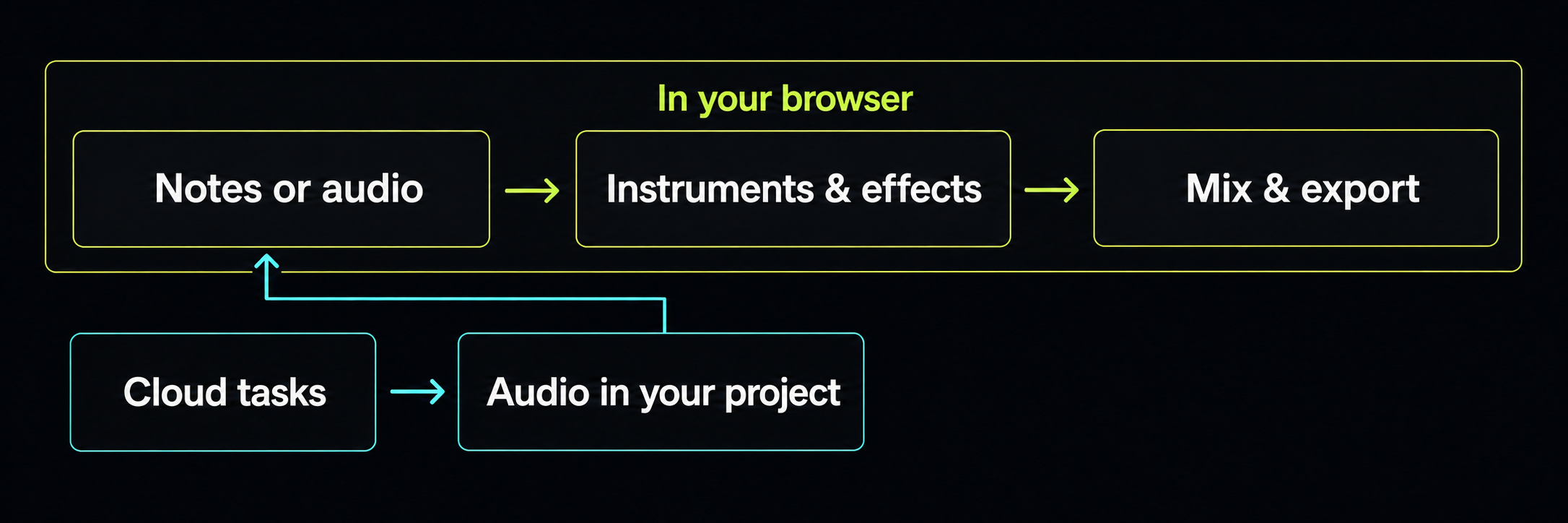 A simplified conceptual diagram. It describes responsibilities, not internal algorithms or the exact sequence of every operation.
From notes to sound
MIDI is not sound by itself. It tells an instrument about pitch, start time, duration and expression. The instrument turns those events into audio. Changing an instrument can therefore preserve the melody while changing its character.
Some instruments synthesise sound; others use recordings. Multisampling uses recordings for different pitches and ways of playing. Velocity layers provide different playing strengths. Round robin alternates repeated hits or notes between samples, making repeats less like copies of one recording.
An instrument's natural range is a useful guide. Large pitch shifts can change the character of a recorded sample. Choosing material suited to the register helps preserve a recognisable timbre.
What Sound Engine 2 does
The sound engine connects sources, tone shaping, dynamics and processing. From a user's perspective, this means working with waveforms, harmonics, envelopes, filters and effects in a common system.
An envelope describes how a sound begins, holds and fades over time. A spectrum describes how energy is distributed across frequencies. Waveform and spectrum are different views of the same sound. A tall waveform alone does not explain why a timbre sounds bright or soft.
Parts meet on the timeline, pass through track settings and then shared master processing. The whole path matters: a good instrument alone does not guarantee a balanced mix.
What uses your browser
Editing, much of audio preparation and playback, and export use your device's resources. Separate workers can handle substantial preparation so the interface does not have to do everything on one thread. This reduces competition with the interface, but does not make the calculations free.
Prepared audio and downloaded samples can be reused, so the same operation may be faster the second time. A file's size on disk is different from the memory occupied by its decoded audio.
Why the cloud is involved
Cloud tasks include finished-audio generation and stem separation. Projects, files and task state are associated with the account. When many requests arrive, work may wait in a queue instead of running all at once.
A server task may continue after its panel is closed. That does not mean every browser operation can safely be interrupted: a local export still needs its tab. Do not assume the whole application is fully offline; the account, cloud tasks and missing resources need a connection.
Explain behaviour without exposing private implementation
Wiki describes behaviour, formats and limitations. It does not publish private keys, internal AI instructions, server configuration or Oscivara's proprietary source code. Third-party open-source information and materials supplied under those licenses remain available in the licenses section.